Polycrisis Anxiety: Moving Through Global Anxiety with Compassion
In an age where a new war seems to break out every month and world leaders make decisions without considering the long-term consequences for humanity, it is no wonder that so many of us live in a state of constant existential anxiety. When we add the climate crisis and the uncertain rise of AI to the mix, that feeling of being worried about things completely out of our control can become truly overwhelming.
If you’re feeling this way, I want to reassure you, it’s not because there is something wrong with you, or because you can no longer "handle" things. It’s actually a sign of a functioning, compassionate heart that deeply cares about the world.
To understand why we feel so paralysed by what’s happening, we first need to look at our internal systems. In Compassion Focused Therapy (CFT), we talk about three emotional systems that need to stay in balance for us to feel well. We have our Threat System, (the protection mode) designed to keep us safe by fighting off danger, our Drive System (the ‘doing’ mode’) that motivates us to achieve goals and find rewards, and our Soothe System, (the ‘being’ mode). This third system is what brings our body back to a state of calm, safety, and connection. Unfortunately, in the world we’re currently living in, it is incredibly easy for the first two to take over and drown out our ability to feel soothed.
This happens because our heads are housing two different "operating systems" that don't always get along. The Old Brain and the New Brain. The Old Brain is millions of years old and its primary job is survival. It operates on a hair-trigger, such as when you see a headline about a global crisis, your Old Brain reacts as if a predator is physically in the room with you, instantly triggering that fight-or-flight response.
Then we have the New Brain, the "thinker. It handles our imagination, logic, and planning. It’s the reason we can form deep relationships and envision a better future. The problem? This New Brain is easily hijacked. Because it can imagine the future, it often ends up ruminating on the past or catastrophising about a future that hasn't even happened yet.
This creates what we call the "tricky brain" loop. You read an article about climate change or a political shift that has dire consequences on humanity, and your New Brain takes in that information. This triggers the Old Brain to detect a threat and release a shot of cortisol. Your New Brain then starts imagining terrifying "what-if" scenarios to explain that sudden jolt of physical fear, which makes the Old Brain even more scared. The result? Our anxiety grows in a self-sustaining cycle. Our Old Brain simply hasn't evolved to handle a 24/7 global news cycle.
So, how do we break the loop? A helpful CBT approach is mastering your "Locus of Control." Most of us, when stuck in these loops, end up "fortune telling" and “Catastrophising” where we predict the worst-case scenarios and convince ourselves they are inevitable. To counter this, we can use an exercise called the Control Circle.
Imagine an Outer Circle, which we’ll call the "Release Zone." Here, we place those heavy systemic issues that our Old Brain perceives as immediate predators, but that we cannot solve alone. These can be things like global conflicts, AI development, or climate change policies. Recognising that these belong in the outer circle isn't about being indifferent, it’s about acknowledging that ruminating on them doesn't change the outcome, but only leaves us feeling hopeless.
Now, imagine drawing an inner Inner Circle. This is where we focus on the small, daily choices that actually regulate our nervous system. This includes your "information hygiene" for example choosing to read one deep-dive article a day rather than doom-scrolling every hour. It also includes your "compassionate output," like donating to a specific cause, doing something for your community, or simply practicing kindness toward someone else who is struggling.
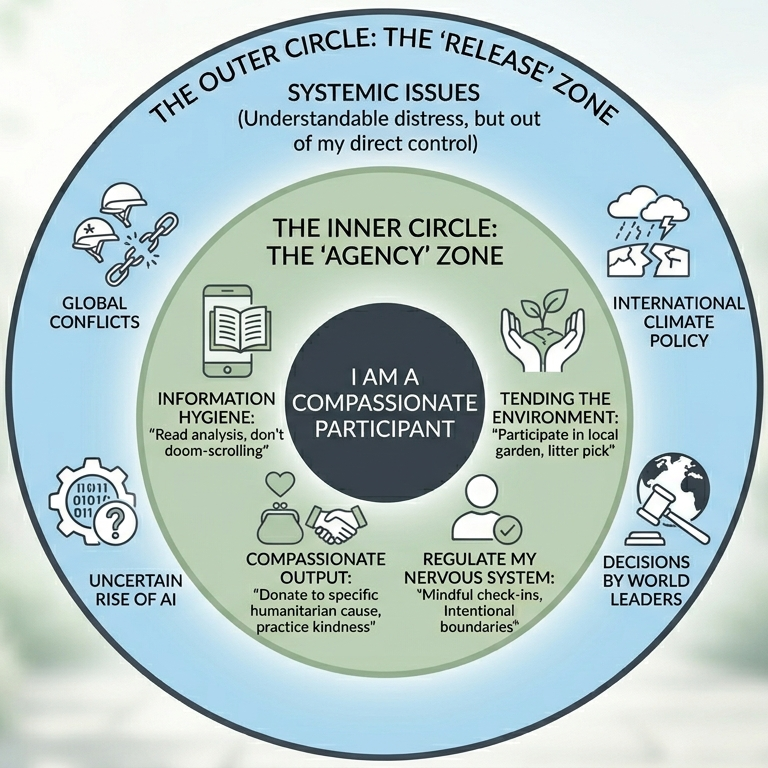
By focusing here, you are effectively "feeding" your Soothe System. You’re telling your Old Brain that while there are threats in the world, you are currently safe enough to take purposeful action. This shifts your narrative from being a "helpless victim of a terrifying future" to a "compassionate participant in a challenging present."
We can further activate this sense of calm by remembering our shared common humanity. We can remind ourselves that millions of people feel this same fear. You are not alone in it. When we shift from "fear-based action" such as “I must act or we all die” to "compassion-based action" such as “I act because I care about the world”, we create something much more sustainable for our nervous systems.
I often say that anxiety is the smoke alarm of the soul. CBT helps us check if there is an immediate fire in our own kitchen, while CFT helps us stay calm and connected while we work together to protect the whole neighbourhood. We don’t need to be fearless to be helpful, we just need to stay compassionate and acknowledge that we’re all in this together
Sometimes the 'New Brain' needs a little extra help to stop the loop. I’ve put together a guided compassion meditation on my Instagram (@mindoverchatter_psych) specifically designed to help you empathise with the world without taking the full weight of it onto your own shoulders. Head over there if you’d like a guided way to step back into your 'being' mode today.